
The information in this biography was published in 2015, based on interviews prior to that date. Later events and accomplishments may not be included.
Emmett Hughes
Image
Name
Hughes, Emmett
Dates
1921-2011
Where Raised
Residence
Occupation
farmer, carpenter
Style
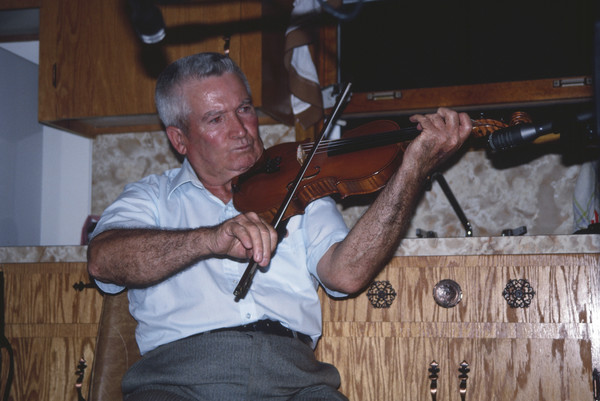
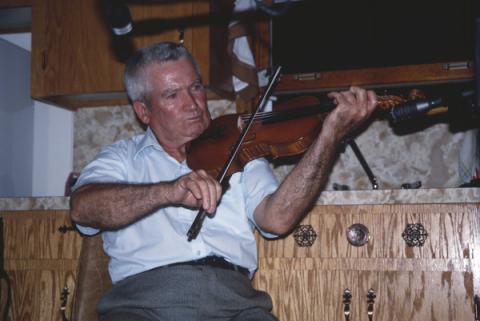
Emmett Hughes grew up in a prominent fiddling family from Northeastern Queens County. When he was only 5 or 6, he could remember and "jig" tunes so well that his father Dan Hughes would often send him to learn tunes played on a neighbor's spring-powered gramophone (Emmett would then jig or whistle the tune for his father to learn on fiddle). Like other Islanders of his era, Emmett also learned to square dance at a young age; he understood that you would not be permitted to join a set unless you had learned properly.
As a young man Emmett played for countless schoolhouse dances, house parties, and country weddings (more on weddings). He also competed in many fiddle contests, of which he certainly won his fair share: most notably a Charlottetown event in 1967 billed as the Maritimes Fiddling Championship. Emmett toured around the Island on several occasions with famed Cape Breton fiddler Winston Fitzgerald, for whom he sometimes served as an opening act. In the 1980s, he started composing his own tunes, and in the early 1990s he published a book of original tunes called A Composition of Fiddle Tunes. A few years later he published a second volume of original tunes. Some of Hughes' orginals appear here in two medleys, beginning with The Melba Tree and Rachel's Favorite, respectively.
All of the music appearing here was recorded in 1991. Hughes had been suffering severely from arthritis for several years and had pretty much stopped playing by the 2006 session, which was exclusively a verbal interview.
Of special interest to fiddlers: Hughes demonstrates commonly used double stops for several keys, using for illustration the well known Island tunes Princess Reel and Heather on the Hill.
Images


Tune Selections
Oral histories
| Demonstration: common double-stops | Characteristic double stops for common keys; passages from "Princess Reel," and "Heather on the Hill" used for illustration | info and transcript |
| Country weddings | General Description; weddings went through the night and into the morning; mention of 8-hand reels | info and transcript |
| Merchants Take Payment in Kind | Borrowing money for fertilizer; stores would come and take payment in kind (potatoes) in the fall; harvesting methods, hauling potatoes to train depots in special cars. | info and transcript |
| Learning to square dance | Learning to dance as a youngster; wouldn't get into a set until you learned how; people learned to dance mostly by watching, but neighbors would help you learn; you also learned to dance at recess time in the schools | info and transcript |
| What folks wore at house parties | How people dressed; shoes in the mudroom | info and transcript |
| Tunes from the gramophone | He could jig tunes at 5 or 6 years old; his father would send him to learn tunes from a neighbor's gramophone | info and transcript |
| More wedding details | More details on weddings | info and transcript |
Videos
Accompanied by: Gary Hughes, pno